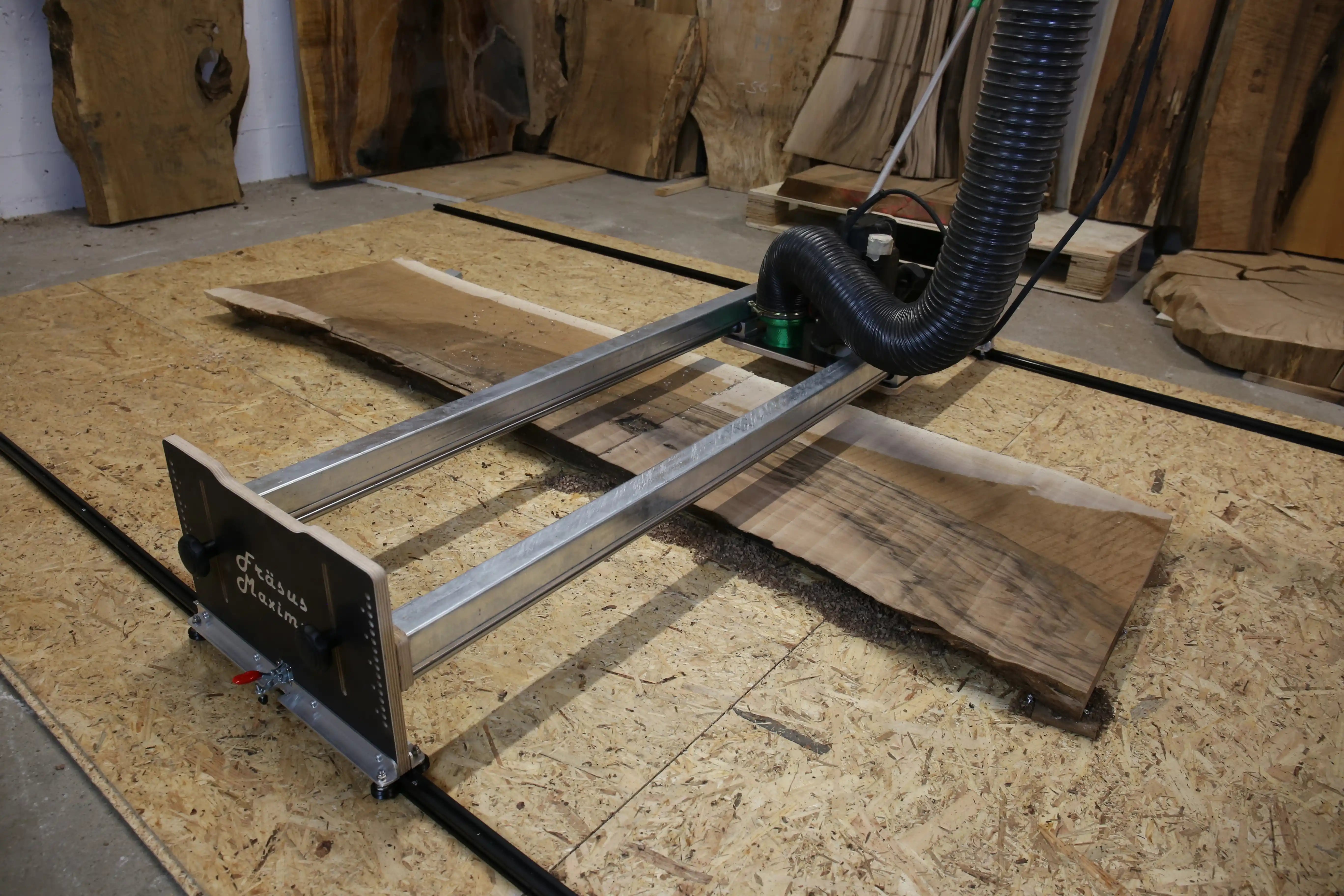
Large wood slabs, tree slices and epoxy tables often look impressive in their raw state – but they are almost never truly flat. Wood moves, warps and builds up internal stresses. If it's going to become a clean table top or an accurately fitting piece of furniture, the surface first needs a true reference plane.
In this article you'll learn why planing often isn't enough for large or warped workpieces, why tree slices need to be treated differently, and how to flatten a wood slab with a router in a controlled way.
In short: when does flattening make sense?
Flattening with a router makes sense especially when a workpiece is too large, too warped or too delicate for conventional planing machines. Typical cases are wide solid wood slabs, tree slices, epoxy tables, irregular planks or glued-up table tops that are no longer perfectly flat after glue-up.
Why large wood slabs are so hard to get flat
Wood isn't a homogeneous material. It absorbs moisture, releases it again and changes shape in the process. Wide planks, table tops and tree slices in particular warp due to drying, grain direction and internal stresses. As a result, a surface can become wavy, twisted or cupped.
The problem: for furniture making, table tops, frames, glue-ups or epoxy projects, a surface that merely looks smooth isn't enough. What matters is that a defined plane is created. Only then can the workpiece be reliably processed further, sanded, assembled or glued.
Visually smooth
The surface feels clean, but can still have waves, twist or bowing.
Truly flat
The surface lies in a defined plane. That's exactly what table tops, coffee tables and much more need.
Why a thickness planer doesn't automatically straighten warped wood
A thickness planer mainly produces a consistent material thickness. In other words, it makes a board equally thick, but not necessarily flat. If a warped board only touches down at certain points or is pressed down slightly by the feed rollers, its original shape can partly remain.
The result may then be similarly thick everywhere, yet still bowed or twisted. For narrow boards that have already been face-jointed, a thickness planer works very well. For large, warped wood slabs, however, it isn't the most reliable way to create a true reference plane.
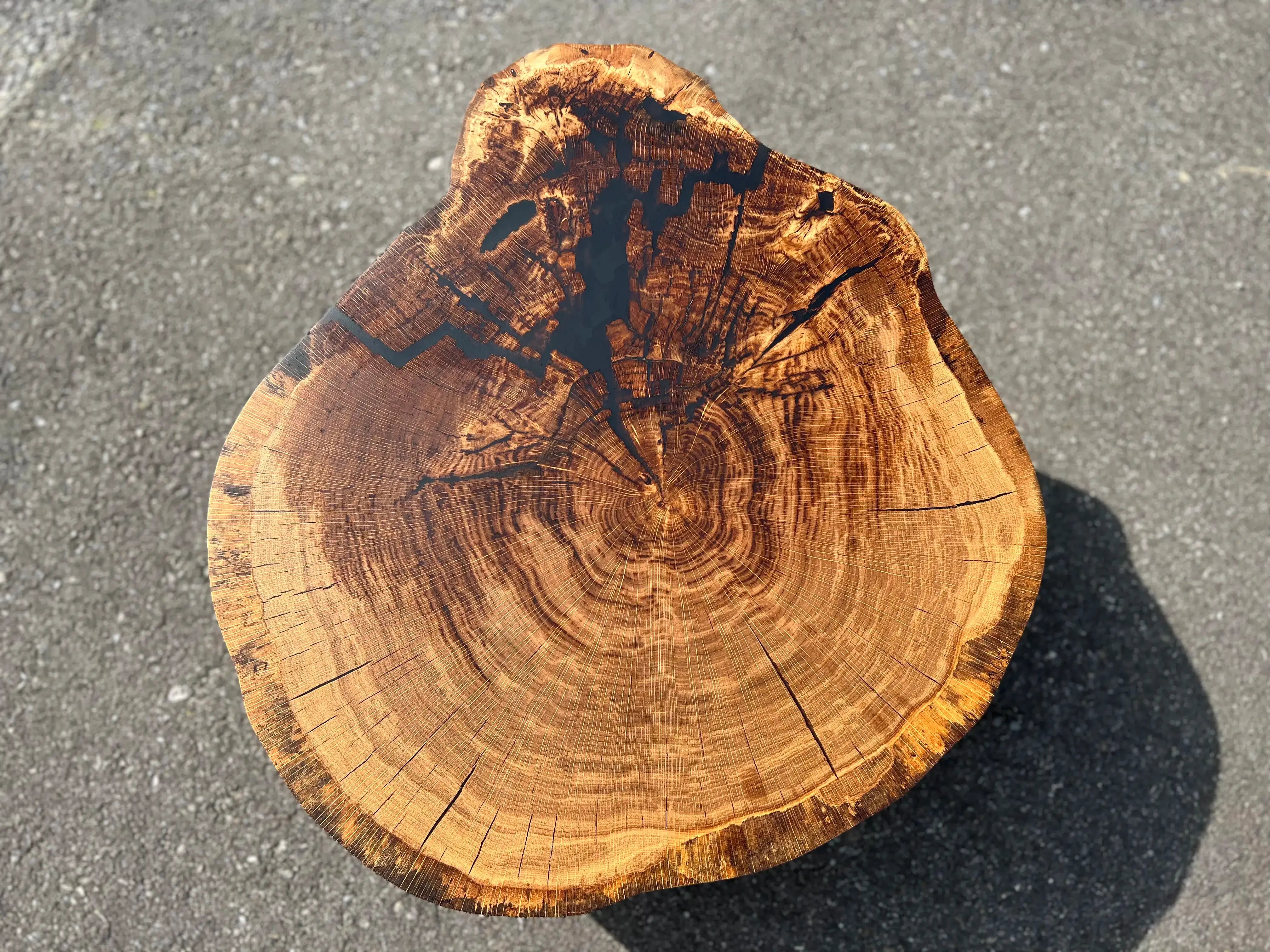
Why tree slices shouldn't be planed
Tree slices consist mostly of end grain. The wood fibres run perpendicular to the surface. Planing machines, however, are designed for long grain, where the fibres run parallel to the direction of cut.
If a tree slice is fed through a planer, the knives hit the ends of the fibres. This can lead to heavy tear-out, rough surfaces and damaged blades. Cracks, knots or irregular grain increase the risk even further.
Rule of thumb
Tree slices shouldn't be planed but milled. A router with a suitable flattening bit and rigid guidance is far better suited for this.
Planing or flattening with a router – which is better?
The question isn't whether planing is bad in principle. Planing and router flattening solve different problems. Planing makes sense when the workpiece fits the machine and can already be guided in a controlled way. Router flattening makes sense when size, warp or material structure rule out planing.
| Method | Well suited for | Limitation | Result |
|---|---|---|---|
| Thickness planer | narrow boards that are already face-jointed | too little working width; warp can remain | consistent thickness |
| Jointer | edges and narrow boards | large slabs and tree slices usually don't fit | reference surface on suitable workpieces |
| Hand plane | smoothing, finishing, traditional surfaces | requires a lot of experience; no easy defined plane on large surfaces | smooth surface |
| Router flattening | large wood slabs, tree slices, epoxy tables | needs rigid, play-free guidance | truly flat reference plane |
How does flattening with a router work?
When flattening, the workpiece is fixed in place while a router is moved across the surface in a guide. The router doesn't follow the warped wood but the guidance of the router sled. That's exactly how a new, defined plane is created.
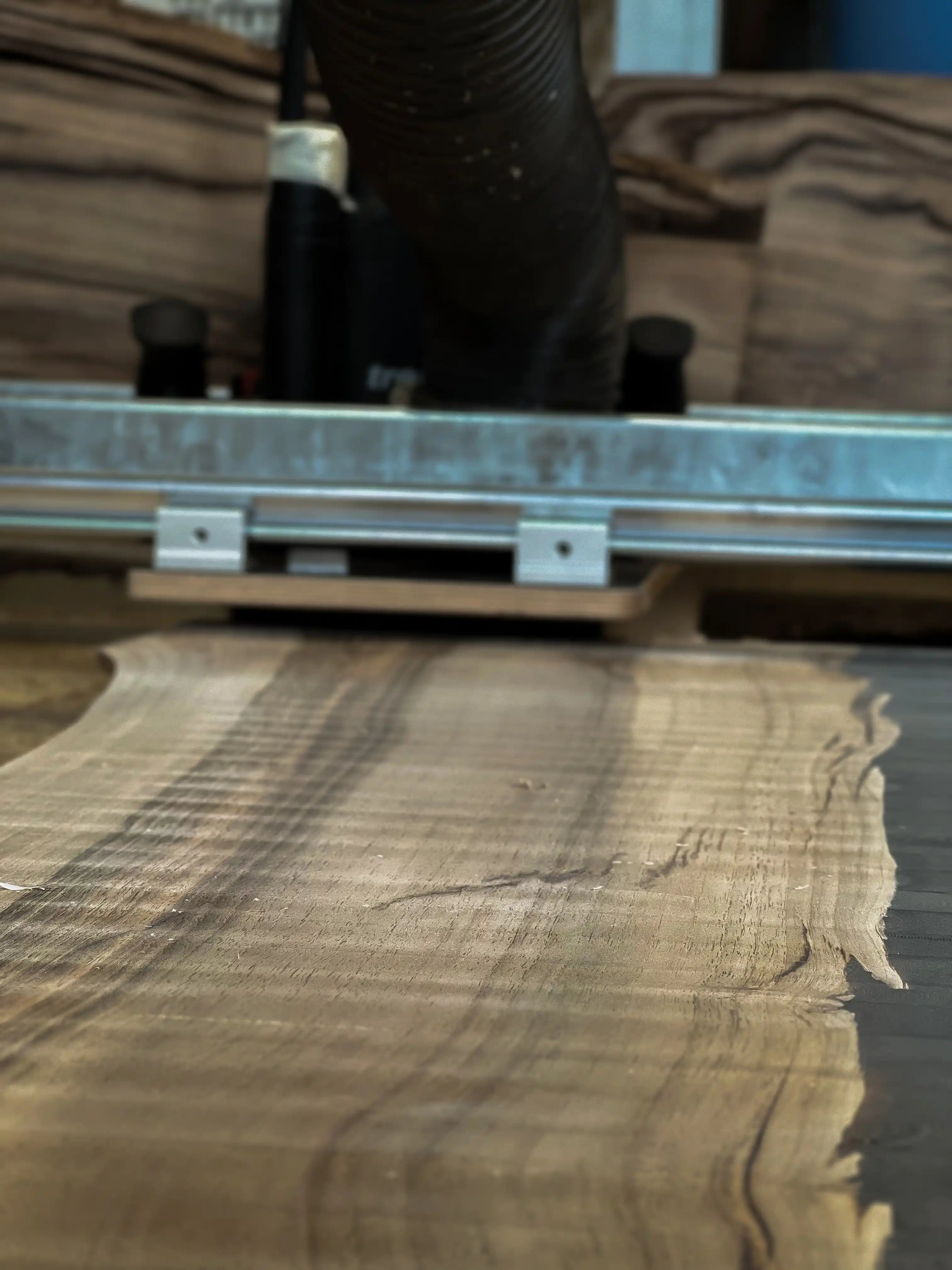
The bit removes the highest points first. Then the cutting depth is increased step by step until the entire surface has been cleanly milled. Once one side is flat, the workpiece can be flipped. The milled side then serves as the support for machining the second side parallel to it.
The key difference
When planing, the workpiece has a strong say in how it gets machined. When flattening with a router, the router's guidance defines the plane. That's why router flattening is so effective on warped and large workpieces.
Flattening a wood slab: step by step
The exact procedure depends on the workpiece, the bit and the setup. But the basic principle is always the same: support it securely, find the highest point, take shallow cuts and mill pass by pass in a controlled way.
Support the workpiece securely
Place the wood slab, tree slice or table top on a stable base. It's important that the workpiece doesn't wobble, tip or give way while milling. With irregular undersides, wedges, sacrificial strips or shims can help keep the workpiece steady.
Find the highest point
Before milling, find the highest point of the surface. Set the first cutting depth so that only this highest area is lightly touched. That way you don't remove unnecessary material and you reduce the load on router and bit.
Check the router and guidance
The router must sit firmly in the sled. The guidance should run smoothly but without play. Any deflection, jamming or play can later show up as a groove or wave on the wood surface.
Work in shallow passes
When flattening, a smooth pass is better than an overly aggressive cut. It's better to work in several shallow layers. That's easier on the machine, bit and workpiece and reduces vibration and tear-out.
Mill even passes
Guide the router across the workpiece pass by pass. Choose the side step so that the passes overlap slightly. This avoids unmachined strips and reduces visible transitions between the tool marks.
Machine the second side
Once the first side is flat, flip the workpiece. The already milled surface now sits cleanly on the base. The second side can then be flattened and brought to the desired thickness.
Which router and which bit are suitable?
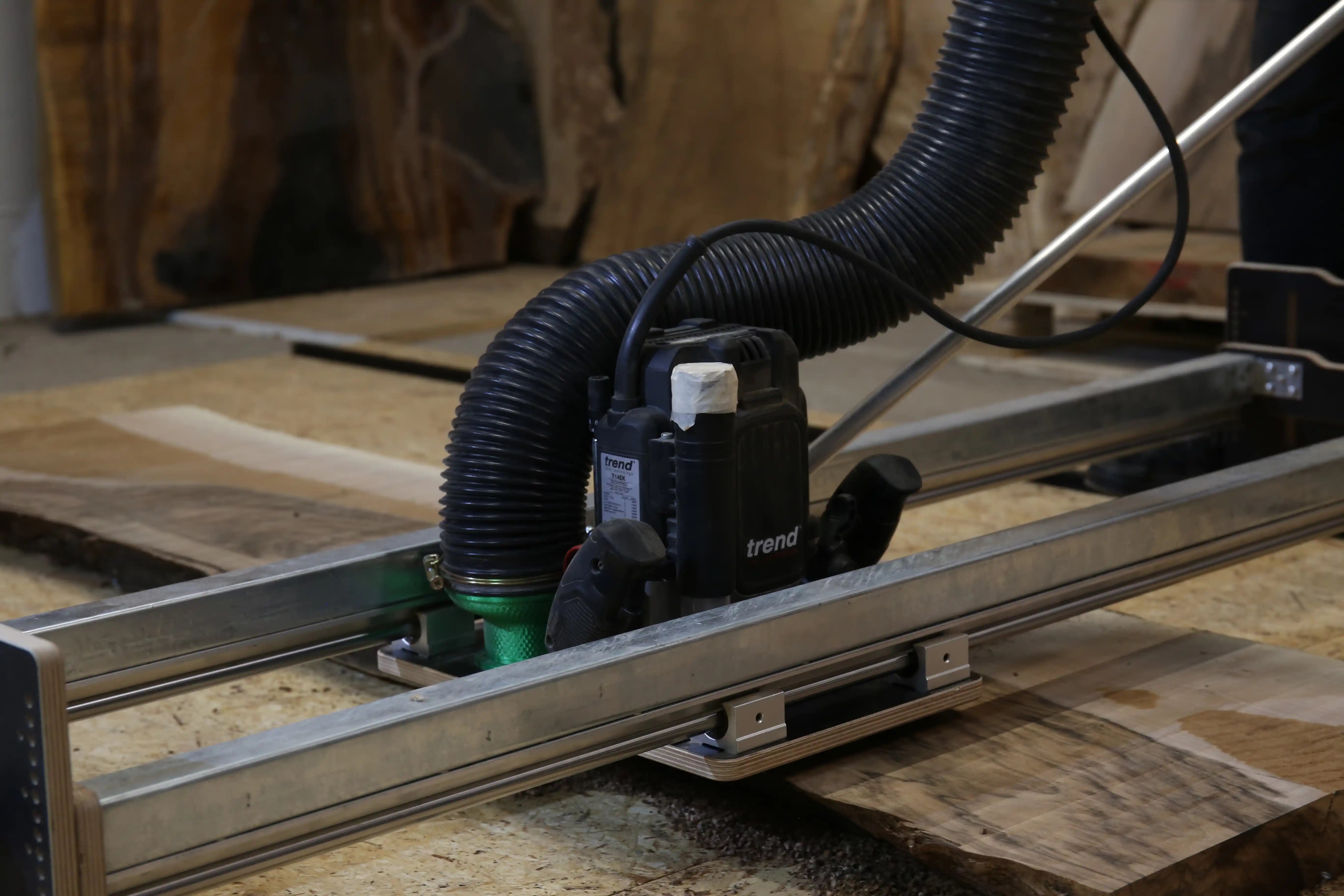
For small workpieces, a mid-range router is often enough. For large wood slabs, tree slices and epoxy tables, a more powerful router makes sense, because long passes and larger bit diameters demand more power. But it's not just the wattage that matters – a stable mount, smooth running and secure guidance count too.
Flattening bits or special cutter heads with indexable inserts are commonly used. A larger diameter reduces the number of passes, but also produces higher cutting forces. That's why bit, router and sled have to match.
- sturdy router with clean depth adjustment
- suitable flattening bit or insert cutter
- firm mounting in the router sled
- the best possible extraction for chips and fine dust
Common mistakes when flattening large wood slabs
Many problems aren't caused by flattening itself, but by a sled that's too weak, cuts that are too deep or uneven guidance.
Cutting too deep
Deep cuts put heavy load on bit and machine. This can lead to vibration, tear-out and rough surfaces.
Guidance too flexible
If the guidance deflects, the surface won't be flat. Stiffness is crucial, especially over long spans.
Play in the movement
Play in guides or rollers is transferred directly to the surface. The result is grooves, steps or uneven passes.
Poor workpiece support
If the workpiece gives way while milling, no clean reference plane is created. The slab has to sit steady and secure.
Why a rigid router sled is crucial
When flattening, the sled isn't just a holder. It defines the plane along which the router is guided. That's why any weakness shows up directly in the finish.
Long spans are particularly critical. The longer the guide, the more noticeable deflection, play and vibration become. Light designs made of thin profiles can work for small workpieces, but quickly reach their limits on large table tops.
A good router sled for large wood slabs should therefore be rigid, play-free and ergonomic to use. It must be able to absorb the weight of the router, the feed forces and the cutting forces without the guide visibly moving.
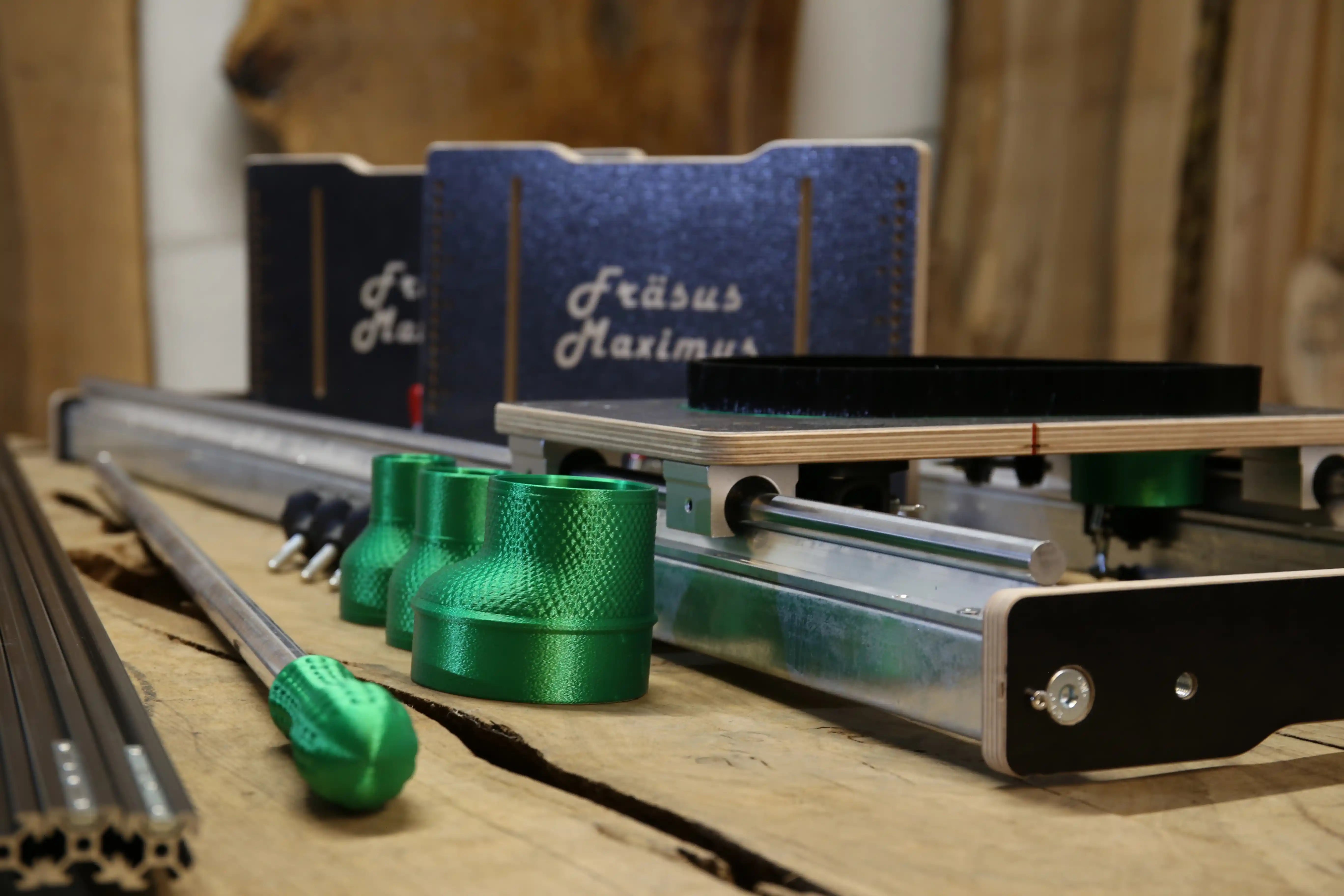
Developed for large wood slabs: Fräsus Maximus
The Fräsus Maximus is a professional router sled designed specifically for large wood slabs, tree slices and epoxy tables. Its solid steel construction, precise guides and large working area ensure that even wide workpieces can be flattened in a controlled and repeatable way.
- Working area up to approx. 300 × 150 cm
- solid steel construction instead of light aluminium extrusions
- smooth and controlled guidance of the router
- suitable for solid wood slabs, tree slices and epoxy tables
- developed for clean flattening of large workpieces
Which workpieces is router flattening particularly suited for?
Router flattening is always interesting when conventional machines fail because of width, material structure or workpiece shape. This most often applies to the following:
Large table tops
Wide solid wood slabs often don't fit through a jointer or thickness planer. With a router sled they can still be flattened.
Tree slices
Because of the end grain, tree slices are problematic for planing machines. Router flattening is usually the safe and clean method here.
Epoxy tables
Wood and epoxy resin can be brought to a single plane in a controlled way with a suitable router.
Glued-up panels
Glue-ups often leave small height differences. These can be removed cleanly by flattening.
FAQ: Common questions about flattening wood slabs
How do I get a large wood slab truly flat?
A large wood slab is most reliably flattened with a router in a rigid router sled. The machining plane isn't defined by the warped wood surface but by the router's guidance. This creates a true reference plane.
Can you plane tree slices?
Tree slices shouldn't be planed, because the wood fibres are perpendicular to the surface. The knives of a planer therefore hit end grain. This can lead to tear-out, rough surfaces and damaged knives.
Which is better: planing or router flattening?
Planing is good for bringing suitable boards to thickness or jointing edges. Router flattening is better when large, warped or irregular workpieces need a truly flat surface.
Which router do you need for flattening?
For small surfaces, a mid-range router is often enough. For large wood slabs, tree slices or epoxy tables, a powerful and sturdy router makes sense. A suitable bit, secure mounting and play-free guidance are also crucial.
How deep should you cut when flattening?
When flattening, it's better to work in several shallow passes. A small depth of cut reduces load, vibration and tear-out. Especially on large surfaces, a smooth, even feed is more important than the deepest possible cut.
Conclusion: router flattening makes large wood slabs flat in a controlled way
Planing machines are excellent for many woodworking tasks. But with large, warped or irregular workpieces, they reach clear limits. A thickness planer mainly makes wood equally thick. A hand plane can smooth. And a tree slice shouldn't go through a planer anyway because of the end grain.
If a large wood slab needs to be truly flat, flattening with a router is the cleanest method. What matters most is a rigid and play-free router sled, because it directly determines the final surface.
Want to flatten large wood slabs cleanly?
The Fräsus Maximus was developed for large wood slabs, tree slices and epoxy tables – with a sturdy steel construction, controlled guidance and a large working area.

Share:
Flattening Tree Slices – How to Get End Grain Truly Flat
Welche Oberfräse eignet sich zum Planfräsen?