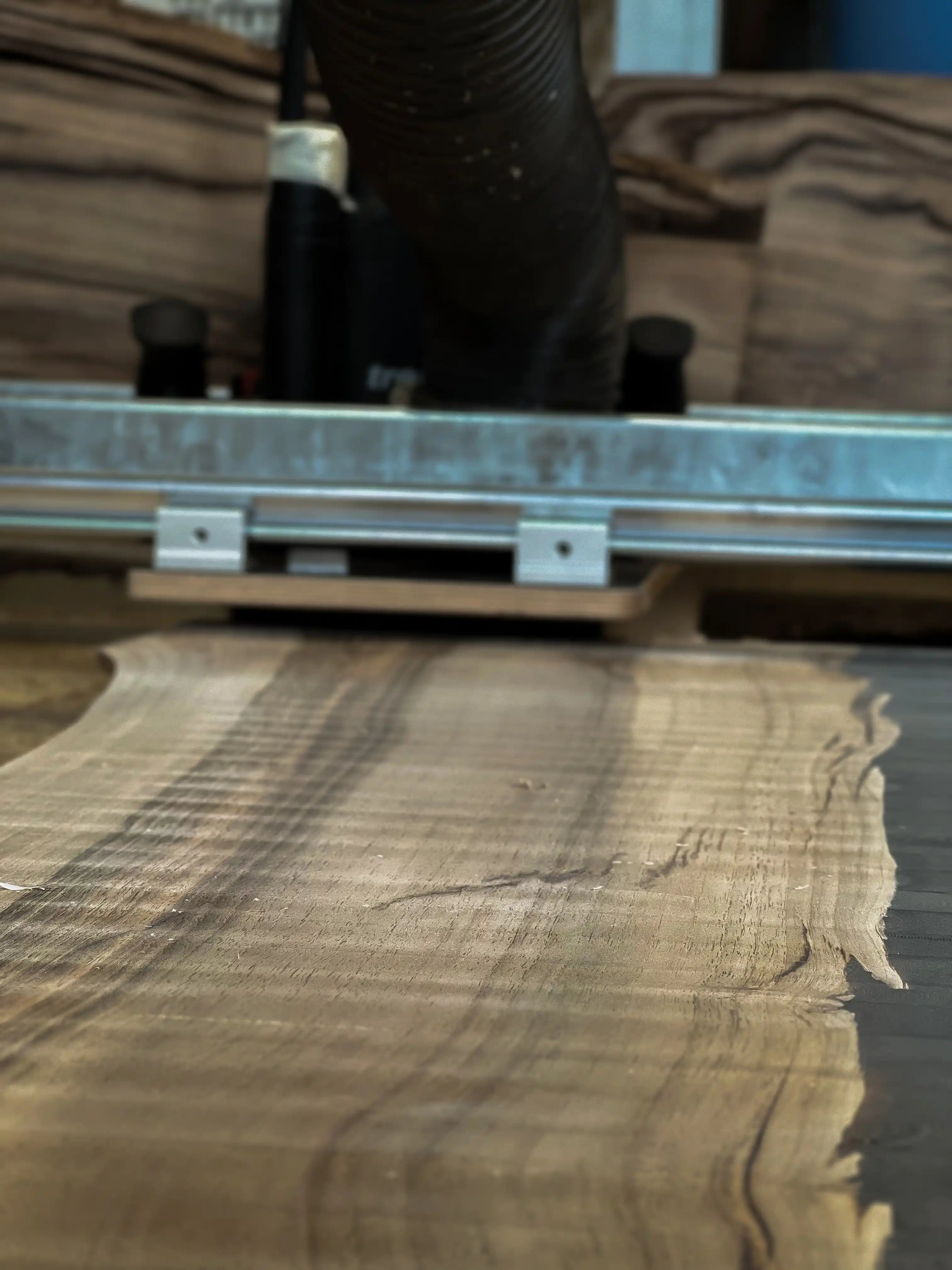
When flattening large wood slabs, it's not just the router sled that determines the result. The right flattening bit also has a big influence on finish, working time, tool marks and the load on the router.
A question that comes up especially often: should you use a small bit because it runs more easily – or a wide flattening bit because fewer passes are needed? The short answer: for large wood slabs, tree slices and epoxy tables, the sensible range is usually between 35 and 60 mm.
In short: the best flattening bit is a compromise
A flattening bit for wood slabs should be wide enough that you don't end up with unnecessarily many passes. At the same time, the diameter mustn't be so large that the router, shank, cutting edges and guide are overloaded. That's exactly why the range of roughly 35 to 60 mm is so interesting for many applications.
Why narrow bits are a problem on large wood slabs
You can flatten a wood slab with a narrow bit in principle. Technically it works. In practice, though, it quickly becomes inefficient because a large surface requires a great many passes.
Each pass overlaps the previous one. The more passes there are, the more transitions there are. And exactly at these transitions, slight steps, lines or visible tool marks can appear. This is particularly annoying on large table tops, tree slices and epoxy surfaces, because the surface remains visible over a large area later on.
Many passes
A small diameter means more passes, more overlaps and more time. The likelihood of visible transitions increases.
Fewer transitions
A wider bit covers more area per pass. This reduces the number of transitions and makes the surface more even.
The ideal diameter: 35 to 60 mm
For flattening large wood slabs, a flattening bit with a diameter of 35 to 60 mm is the best compromise in many cases. This range is wide enough to machine large surfaces efficiently, yet still within what powerful routers can drive in a controlled way.
| Diameter | Suitable for | Advantage | What to watch out for |
|---|---|---|---|
| up to approx. 30 mm | small surfaces, narrow workpieces, lighter routers | lower cutting forces | many passes and more visible transitions |
| 35–40 mm | wood slabs, smaller tree slices, routers with medium to good power | good compromise between smooth running and surface coverage | clean guidance and an even feed remain important |
| 40–60 mm | large table tops, epoxy tables, powerful routers from about 2000 W | fewer passes, fewer transitions, faster work | higher cutting forces; the sled must be rigid and play-free |
| over 60 mm | special cases with a very powerful machine and a suitable setup | very high surface coverage | check load, heat, safety and compatibility carefully |
Practical recommendation
If you're unsure, a flattening bit of around 35 to 40 mm is often the safer choice. It runs controllably, puts less load on the router and still delivers much better surface coverage than a very small bit.
Why the bit diameter shouldn't be as large as possible
A large diameter always sounds better at first, because more area is removed per pass. But it's not quite that simple. With a larger diameter, peripheral speed, cutting forces and the load on router, shank and guide all increase.
The cutting edge on the outside of the bit moves faster than on a smaller bit. At too high a speed, more heat can be generated. This increases the risk of burn marks, dull edges or poorer surfaces – especially with hardwood, epoxy resin or a slow feed.
Simple principle
The larger the bit diameter, the higher the peripheral speed at the cutting edge. That's why the diameter has to match the speed, the router and the material.
In practice this means: too small a bit is slow. Too large a bit can overwhelm the machine, cutting edges and guidance. The sensible range lies in between.
Why reducing the speed isn't always the answer
Many people think: if the bit is large, just reduce the speed. In theory that sounds logical. In practice, though, a router often loses noticeable power and torque at greatly reduced speeds.
If the speed is lowered too far, the bit can feel weak, tear more or vibrate. This worsens the finish and stresses the cutting edges. It's better to choose the bit diameter to suit the router's power.
Too high a speed
Can cause heat, burn marks and faster edge wear.
Too little torque
Can cause tearing, vibration and a rough surface.
Suitable diameter
Takes load off the machine and ensures controlled, repeatable work.
Indexable inserts or fixed cutting edges?
For flattening large surfaces, flattening bits with indexable inserts make particular sense. The reason is simple: when flattening, a lot of material is machined over long distances. Wood, knots, glue lines, epoxy resin and fillers put heavy strain on the cutting edges.
With an insert cutter, a dull edge can be rotated or replaced. So you don't have to replace the whole bit straight away. In the long run, that's much more economical on large projects.
| Bit type | Advantages | Drawbacks | Recommendation |
|---|---|---|---|
| Fixed cutting edges | simple design, often inexpensive to buy | once dull, the whole bit usually has to be replaced or resharpened | more for smaller jobs |
| Indexable inserts | edges can be rotated and replaced; consistent quality | higher purchase price | ideal for large wood slabs, tree slices and epoxy tables |
Important with epoxy resin
Epoxy resin with pigments, fillers or dust particles can put heavy strain on cutting edges. For large epoxy tables, replaceable indexable inserts are therefore particularly useful.
What role does the depth of cut play?
Even the best flattening bit won't help much if you mill too aggressively. Especially on large surfaces, a small depth of cut is often the cleaner solution. Router and bit run more smoothly, the edges are under less strain and the surface becomes more even.
Instead of removing as much material as possible at once, work in several controlled passes. The first pass is for finding the highest points and lightly removing them. Then increase the depth step by step until the entire surface is flat.
Find the highest point
Set the router so that the bit initially only touches the highest points of the slab. That way you don't remove unnecessary material.
Take shallow cuts
It's better to work in several shallow passes than with one deep cut. This reduces vibration and spares the cutting edges.
Overlap the passes slightly
Choose the side step so that the passes overlap. This avoids unmachined strips and visible steps.
My recommendation from practice
In my experience, a high-quality flattening bit with indexable inserts is the best choice for large wood slabs, tree slices and epoxy tables. Smooth running, clean edge geometry and the option to simply rotate or replace the inserts when they wear are particularly important.
I like working with flattening bits from Fraisertools myself, because the balance of cut quality, tool life and price works well in practice. Especially when flattening large surfaces, it's a big advantage to be able to buy matching inserts individually.
For normal wood slabs
A flattening bit of around 35 to 40 mm is a very good starting point for many wood slabs. It runs smoothly and doesn't put unnecessary load on the router.
For powerful routers
With a powerful router and rigid guidance, 40 to 60 mm can also make sense. This reduces the number of passes considerably.
Why the best flattening bit needs rigid guidance
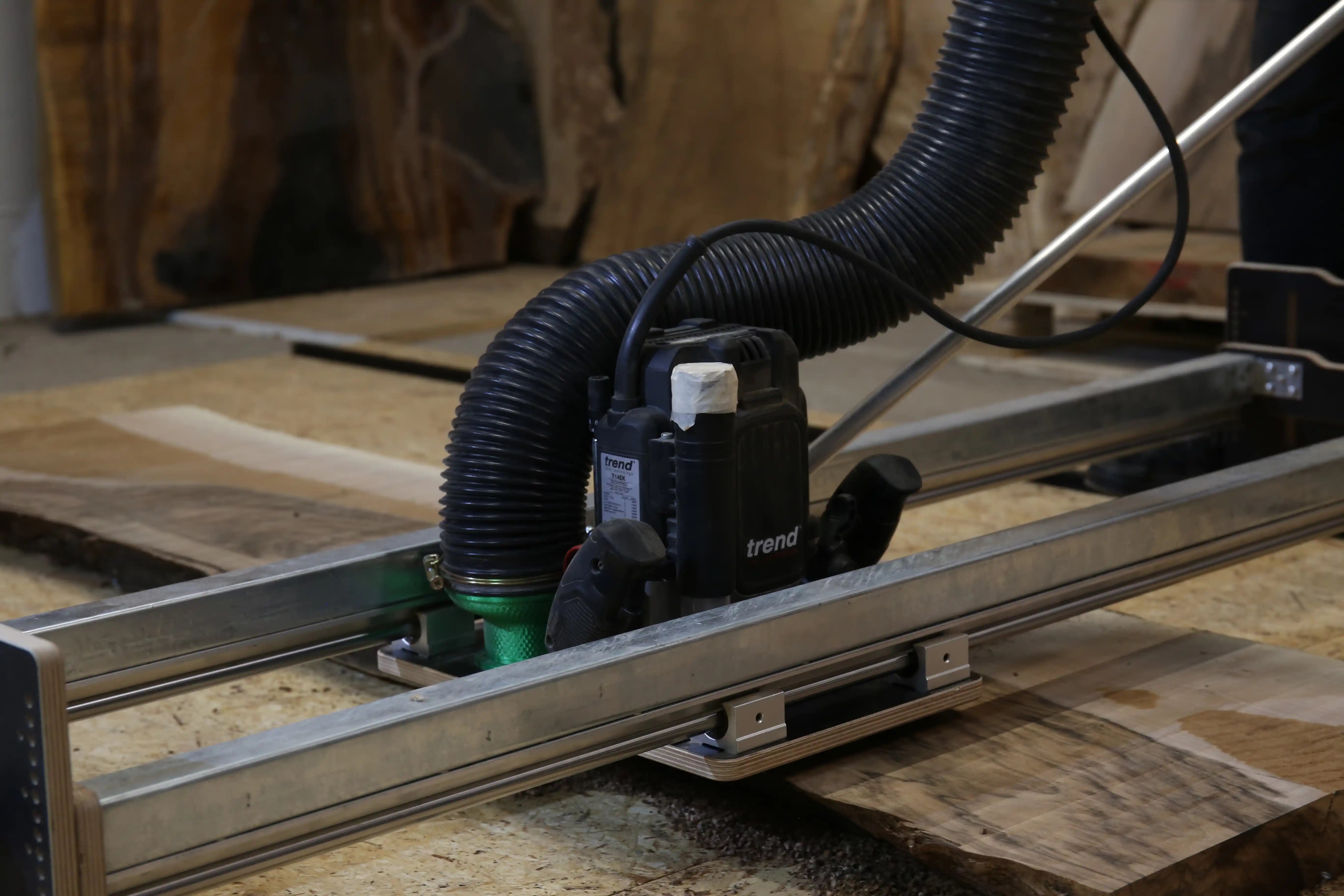
A good flattening bit can only work cleanly if it's guided steadily. The larger the bit diameter, the stronger the cutting forces acting on the router and router sled. If the guide gives way or has play, grooves, steps or vibration appear despite a high-quality bit.
That's exactly why bit and sled belong together. A wide flattening bit only gives a clean result if the router is guided across the workpiece rigidly, without play and in a controlled way.
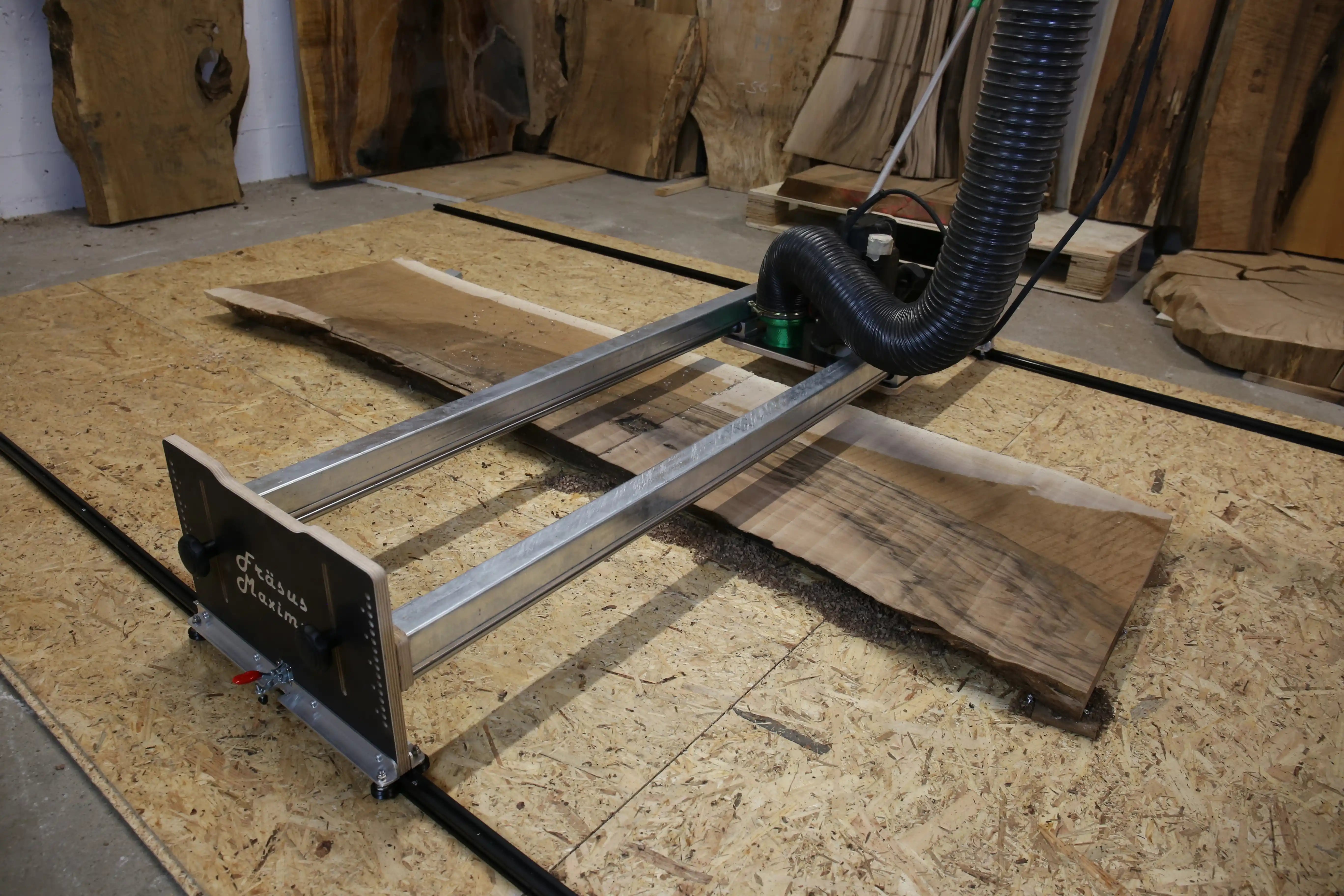
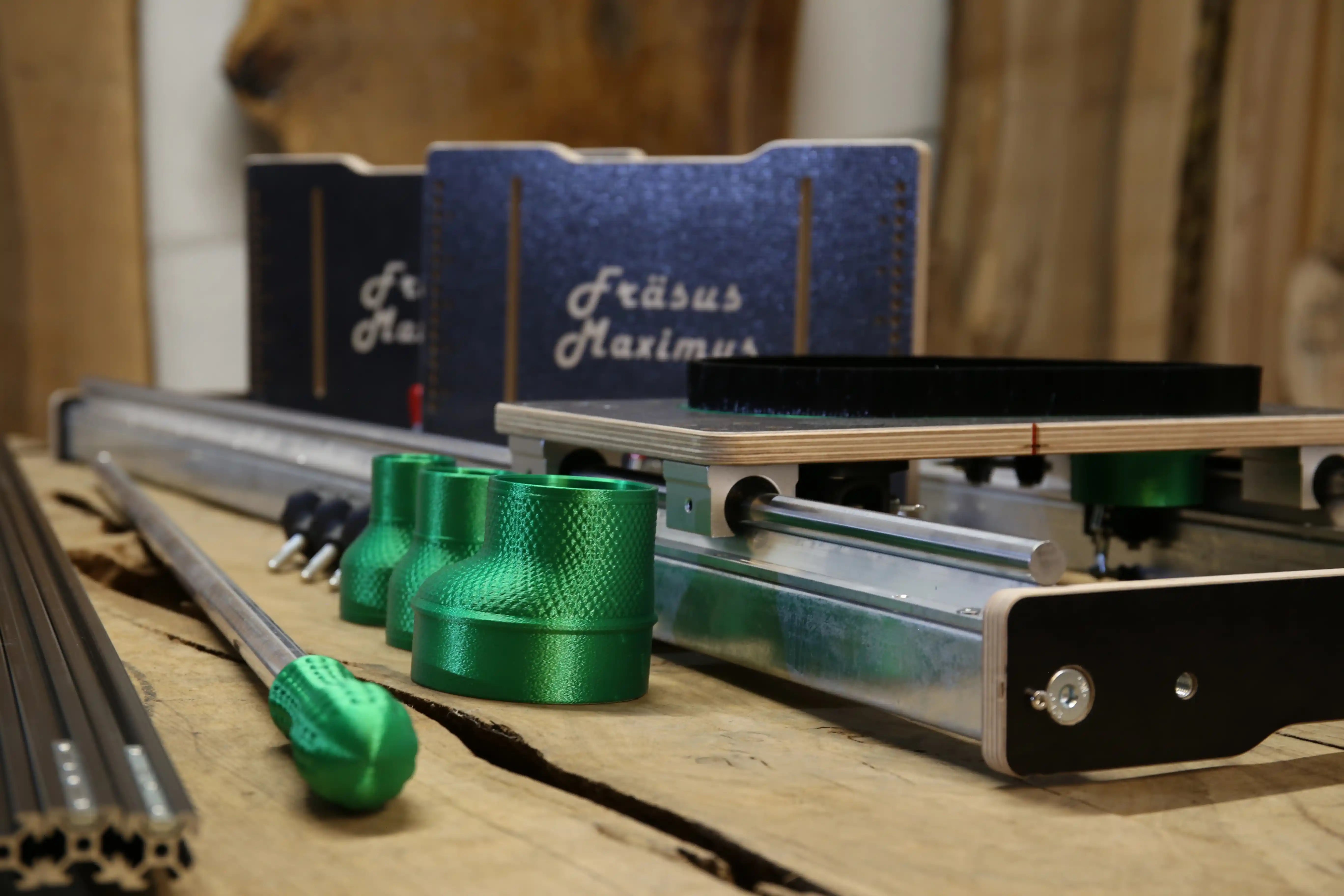
Rigid guidance for large flattening bits: Fräsus Maximus
The Fräsus Maximus was developed for large wood slabs, tree slices and epoxy tables. Its rigid steel construction and controlled guidance help move even wider flattening bits smoothly and repeatably across the surface.
- rigid router sled
- suitable for large wood slabs and tree slices
- controlled guidance for even passes
- working area up to approx. 300 × 150 cm
Common mistakes when choosing a flattening bit
Bit too small
The surface takes unnecessarily long, there are many transitions and visible tool marks become more likely.
Bit too large
The router is overloaded, the edges can get hot and the guide has to absorb considerably more force.
Cheap edge geometry
Unsteady running and poor edges can lead to tearing, tear-out and rough spots – especially with epoxy resin.
Cutting too deep
Too much material at once causes vibration, strains the router and worsens the surface.
FAQ: Common questions about flattening bits for wood slabs
Which flattening bit is best for wood slabs?
For large wood slabs, a flattening bit with a diameter of about 35 to 60 mm makes sense. Smaller bits work, but need considerably more passes. Larger bits require a powerful router and very rigid guidance.
Which diameter is suitable for a router?
For many routers, a diameter of 35 to 40 mm is a good compromise. With powerful routers from about 2000 W and a rigid sled, 40 to 60 mm can also make sense.
Do indexable inserts make sense for flattening?
Yes. When flattening large surfaces, cutting edges wear relatively quickly. Indexable inserts can be rotated or replaced without having to swap the whole bit.
Why do tool marks appear when flattening?
Tool marks often come from too many passes, too little overlap, play in the guide, vibration or too deep a cut. A suitable flattening bit and rigid guidance reduce these marks considerably.
Can epoxy resin be machined with a flattening bit?
Yes, epoxy resin can be machined with a suitable flattening bit. Sharp edges, a small depth of cut, a steady feed and good dust extraction are important. Indexable inserts are particularly practical here, because epoxy can put heavy strain on the edges.
Conclusion: the flattening bit has to suit the router and the surface
For large wood slabs, tree slices and epoxy tables, a flattening bit between 35 and 60 mm is usually the most sensible choice. Small bits cause many passes and transitions. Very large bits increase cutting forces, heat and load.
What matters is the right compromise: a high-quality flattening bit with clean edge geometry, ideally with indexable inserts, combined with a rigid and play-free router sled. Only then do you get truly even, repeatable surfaces.
Want to flatten large wood slabs cleanly?
With the right flattening bit and rigid guidance, wood slabs, tree slices and epoxy tables can be machined in a controlled and even way.

Share:
Using a Router Sled Correctly – Conventional Milling Explained
Flattening Tree Slices – How to Get End Grain Truly Flat