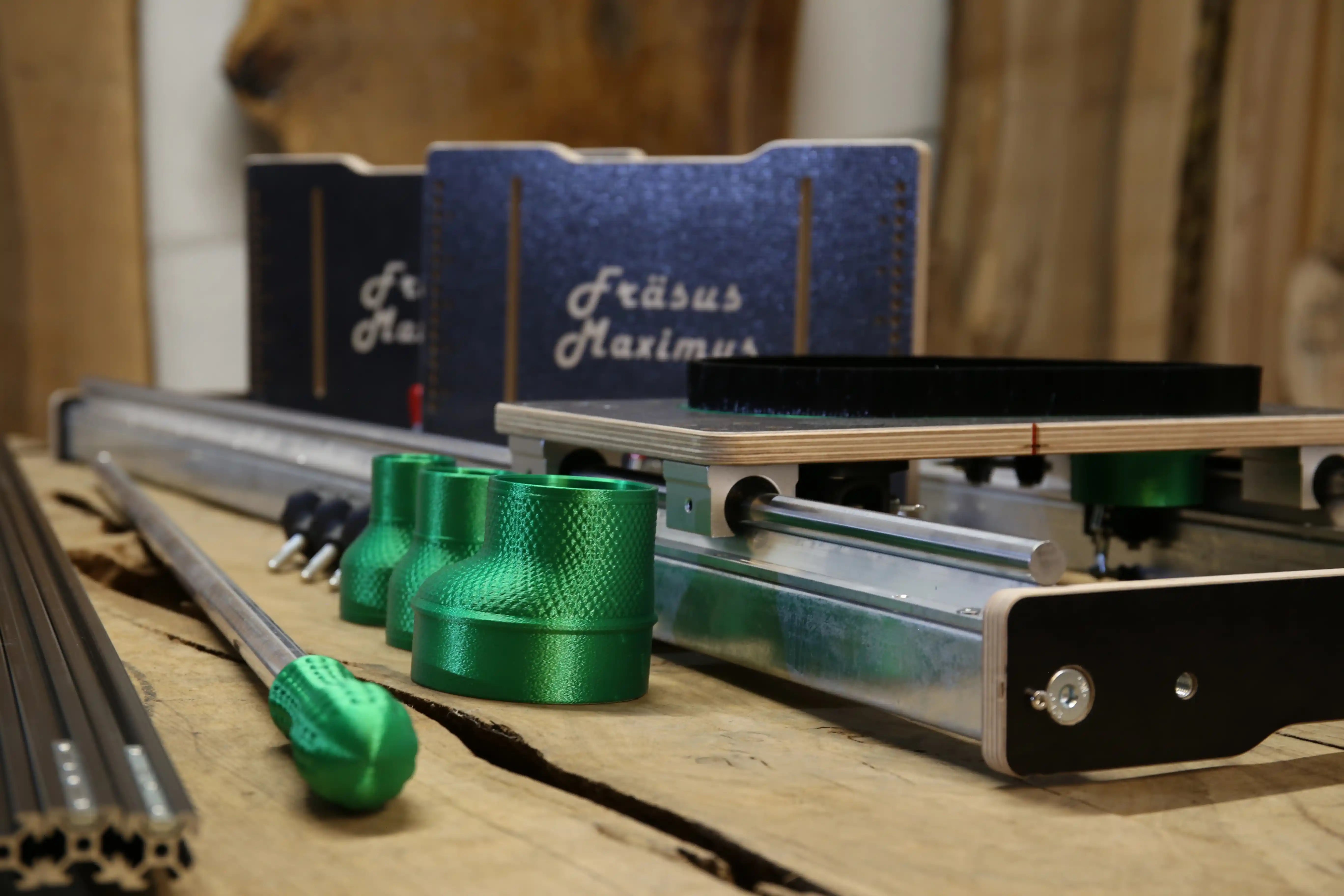
The 4 most important buying criteria
You can't recognise a good router sled by its marketing claims, but by four technical points. They decide whether the router is really guided in a clean plane.
Stiffness
The frame must not deflect under load.
Play-free guidance
The router must not tilt, lift or wander.
Ergonomics
Safe, upright and controlled operation.
Dust extraction
Capture dust and chips right at the cutter.

Fräsus Maximus
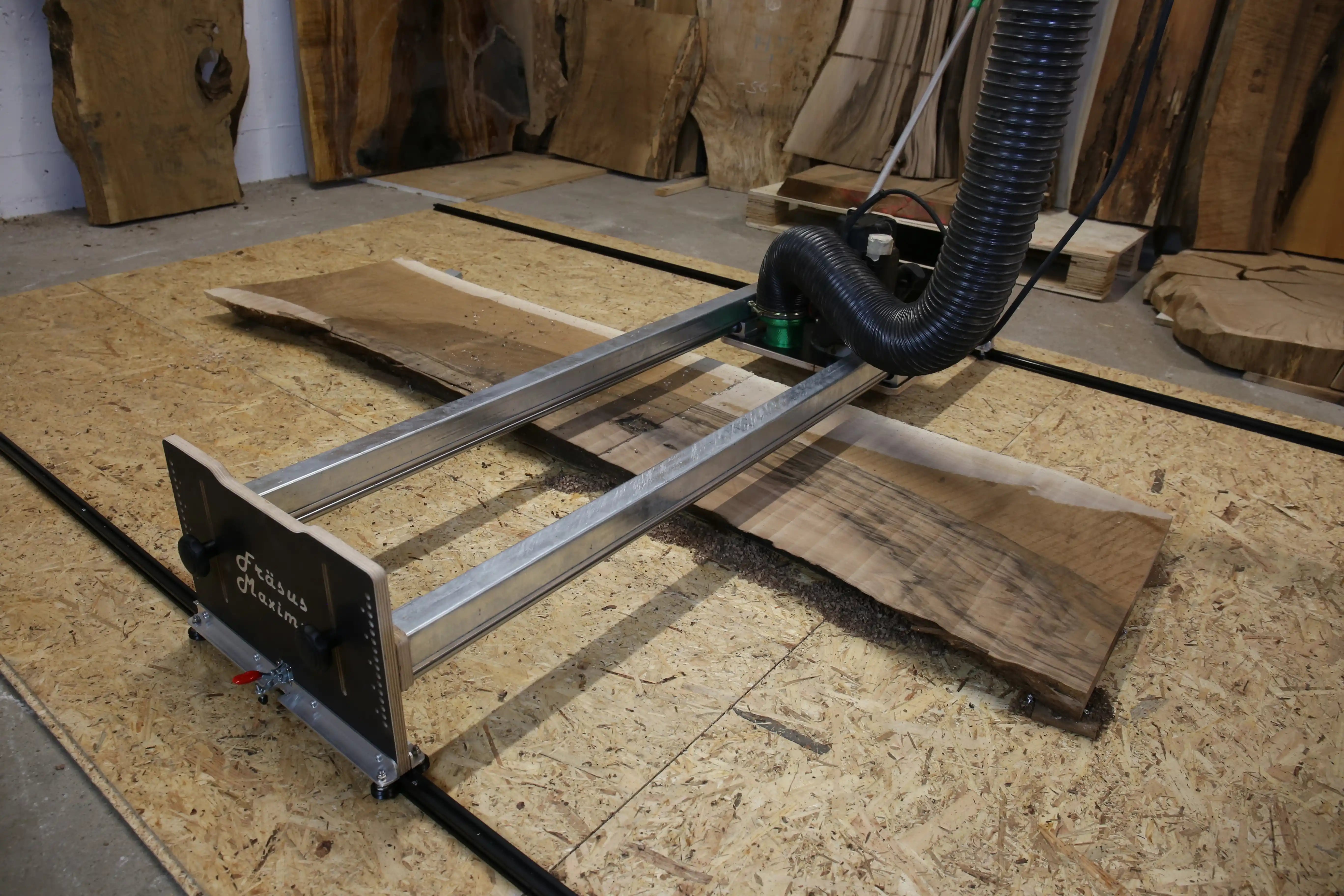
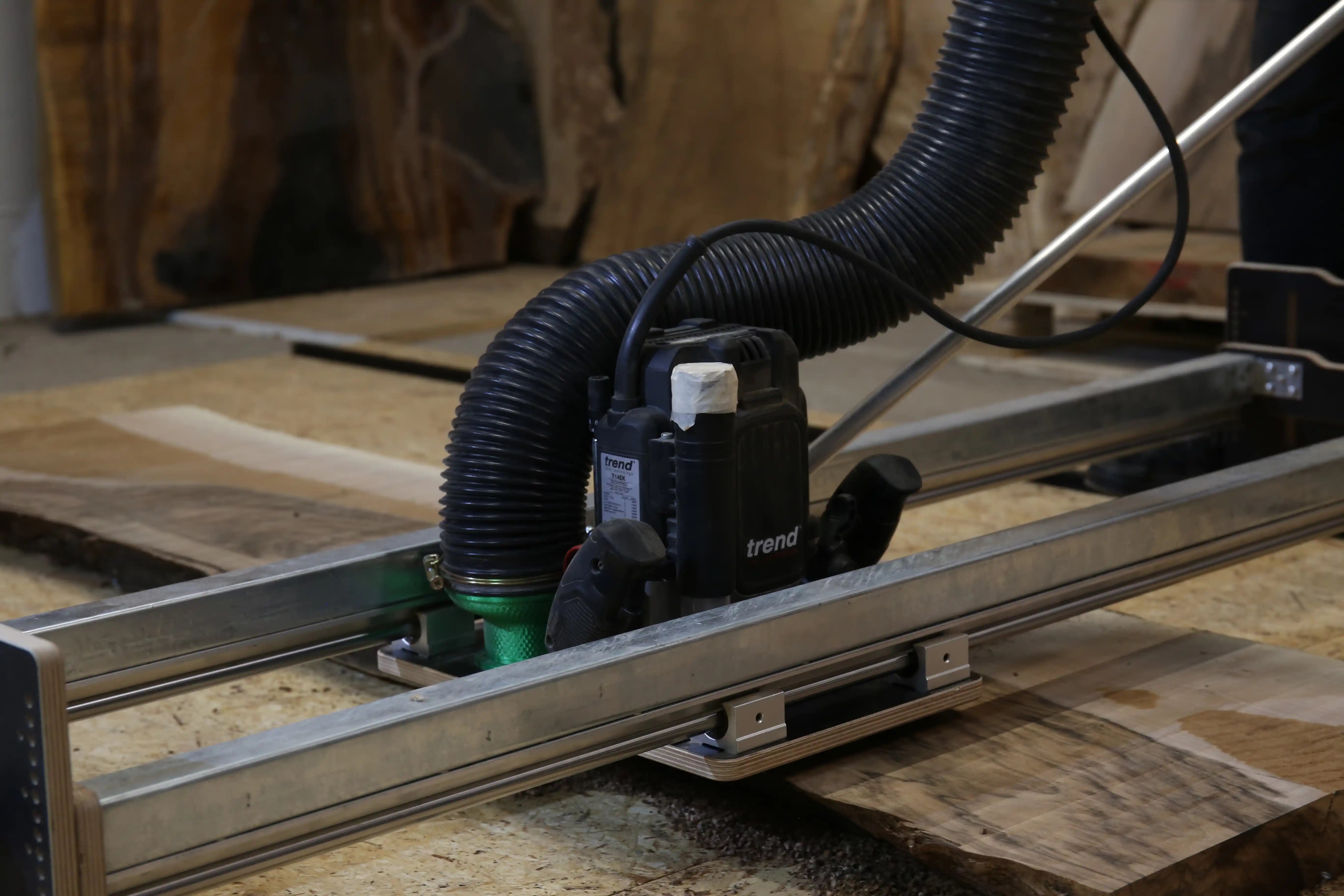
Don't feel like comparing for ages? The Fräsus Maximus meets all four criteria – steel frame, play-free guidance, side operation and extraction at the cutter. Available in different sizes from compact to XXL.
- Steel construction
- play-free guidance
- side operation
- extraction at the cutter
1 · Stiffness – the foundation of every flat surface Details
When flattening, the weight of the router, feed pressure, cutting forces and vibration all act at the same time. If the sled deflects even slightly, the router no longer follows a clean plane – waves and grooves remain that you later have to sand away laboriously. The larger the span, the stronger the effect.
Steel or aluminium? Aluminium is light and practical, but often not stiff enough for large spans. With the same geometry, steel is considerably stiffer – a solid steel frame achieves a stiffness many times greater than a 40×40 mm aluminium extrusion. What ultimately matters, though, is the overall design: profile cross-sections, guidance, bearings and load paths all have to work together.
| Construction | Advantage | Drawbacks | Suitable for |
|---|---|---|---|
| light aluminium extrusions | light, inexpensive | deflection, visible waves | small projects, cutting boards |
| solid steel | high stiffness, smooth finish | higher weight | large slabs, tree slices, epoxy |
2 · Play-free guidance – precision & bit life Details
Good guidance ensures the router glides properly across the workpiece without play – especially with knotty wood, tree slices and wood-epoxy transitions. Slide guides often need some play just to run at all. And that play is exactly the problem when flattening: if the router unit lifts or tilts even slightly, grooves and uneven passes appear.
Preloaded ball and roller guides stay under control even with changing cutting forces – improving surface finish, repeatability and tool life.

3 · Ergonomics & operation – often underestimated Details
One pass over a large slab takes several minutes. Anyone who stands hunched over or reaches over the spinning cutter works unsteadily and unsafely. Safe side operation with a push handle is better – more distance, upright posture, steadier movement.

| Operating concept | Effect | Assessment |
|---|---|---|
| directly on the router | short reach, back pain from bent-over posture | unergonomic on large surfaces |
| push handle with swivel joint | natural force transmission, safe working | easy movement without pain |
4 · Dust extraction – health, visibility, surface Details
Flattening removes a lot of material – chips, fine wood dust and, with epoxy, plastic dust too. Effective extraction sits as close to the cutter as possible: the closer the dust is captured where it's created, the cleaner your surroundings stay and the better you can see what you're milling. Good extraction isn't a luxury accessory but part of working safely.

Bonus · Assessing the working area correctly Details
Many people look at the maximum working area first. But it's only useful if the sled stays rigid over the entire span and the router is guided evenly at every position. So don't just ask “Will my workpiece fit?” but “Does it stay rigid and accurate at this size?” A choice of sizes also makes sense: a compact model for cutting boards and smaller panels, a large one for wide table tops and tree slices.
Common buying mistakes
Most bad purchases happen because people only look at price, size or quick availability – not at what makes clean surfaces.
Only looking at the working area
Big isn't automatically precise. Without stiffness, waves appear over large spans.
Underestimating guide play
Play in slide guides is transferred directly to the surface and amplifies tool marks.
Forgetting dust extraction
Flattening creates a lot of dust. Without extraction it gets messy, unhealthy and hard to see.
Ignoring ergonomics
Poor operation makes the movement unsteady – which hurts both safety and surface finish.
DIY or buy ready-made?
When building your own pays off – and when it doesn't Details
A DIY build can make sense if you enjoy designing and only occasionally flatten small projects. But don't underestimate how many details a good sled needs: rigid profiles, precise guides, a suitable router base plate, safe height guidance, an operating concept and dust extraction.
For large slabs, customer projects or expensive wood, a ready-made, rigid solution is often cheaper than investing many hours in a compromise. Be honest when you calculate: material, development time, failed attempts, guide quality and repeatability.
Buying checklist – 8 questions before you buy Open
- Is it rigid enough for my workpiece size?
- Play-free guidance or just sliding?
- Can I operate it safely from the side?
- Is extraction possible right at the cutter?
- Does my router fit the base plate?
- Can I use a flattening bit safely?
- Suitable for tree slices and epoxy?
- Is the right size available for my project?
Fräsus Maximus – built for large workpieces
A steel frame, a custom-developed swivel joint and play-free guidance ensure a smooth, controlled finish – exactly where conventional or home-made solutions reach their limits. Made in Austria, assembled by hand and tested before shipping.
- solid steel frame – up to 700 % stiffer than 40×40 aluminium
- custom-developed swivel joint – controlled in every movement
- play-free ball & roller guidance
- magnetic clip-on dust shoe, extraction adapters 100/50/35 mm
- in 4 sizes – 150×100 to 300×150 cm
- Made in Austria, hand-assembled & function-tested
- 150 × 100 cmcompact
- 150 × 120 cmcompact
- 300 × 120 cmlarge
- 300 × 150 cmXXL
Frequently asked questions
What should I look for when buying? Answer
The most important criteria are stiffness, play-free guidance, ergonomic operation and effective dust extraction. They decide whether large slabs end up flat or whether grooves and waves appear.
Aluminium or steel? Answer
Why is guide play a problem? Answer
With play, the router can tilt, lift or deflect under cutting forces. This is transferred directly to the surface and creates grooves, steps or uneven passes.
Which size do I need? Answer
The working area has to suit your typical workpieces. The Fräsus Maximus is available in four sizes: 150×100 and 150×120 cm for cutting boards and smaller panels, 300×120 and 300×150 cm for large table tops and tree slices. What matters is that the sled stays rigid and precise across the entire area.
Is buying ready-made worth it compared with building your own? Answer
For large workpieces, expensive material or repeatable results, a ready-made solution pays off. A DIY build seems cheaper, but takes a lot of time and, without precise guidance and a rigid design, often doesn't reach the same quality.
Looking for a rigid router sled for large workpieces?
The Fräsus Maximus was developed for large wood slabs, tree slices and epoxy tables – in four sizes, with a steel frame, precise guidance, push handle and magnetic dust extraction.

Share:
Which Epoxy Resin for Epoxy Tables? My Recommendation
Using a Router Sled Correctly – Conventional Milling Explained