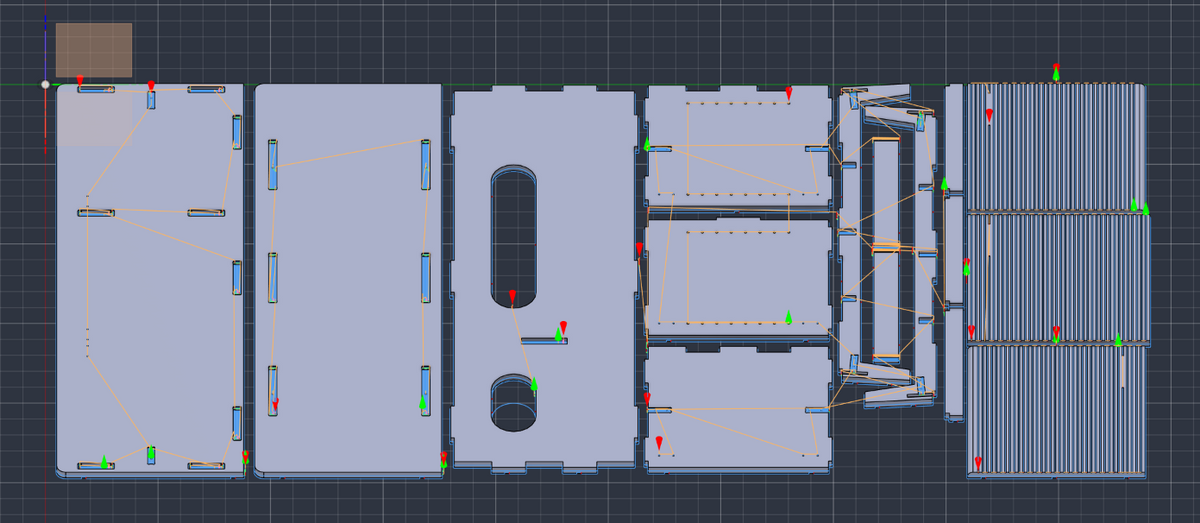
The usual answer to this question is “it depends”. True enough – but you can still say what it depends on. Here's my calculation written out openly, with examples.
What the price is made up of
A milled part isn't priced “per metre of contour”. It costs time, and that time comes in four places:
Checking or creating the drawing, programming the toolpaths. With a clean DXF this is a short item; with a hand sketch it's the biggest part of the preparation. It's incurred once – for a repeat of the same part it's almost entirely dropped.
Placing and clamping the sheet, setting the zero point, changing tools. This item is also fixed per order – which is why one part costs almost as much as five, and why it pays to bundle several parts into one enquiry.
The actual machining. It depends on the contour length, the material thickness (more thickness means more passes), pockets and engravings, and how small the tools have to be. A cleared-out area takes many times longer than a contour of the same size.
What's charged is the sheet area used, not just the part – the waste around it can't be magicked away. If you accept the use of offcuts or supply the material yourself, you save here.

€70/h
For programming, setup and machine time, plus material. I'm writing it here because otherwise you'd have to ask three times to find out.
Three worked examples

Comparing examples 2 and 3 shows the only really big lever: fixed costs are spread over the quantity. Going from one to ten parts never costs ten times as much.
How to keep the cost down
- Send a clean file. Closed contours, no duplicate lines, scale stated – that directly saves preparation time.
- Bundle parts. Everything you'll need in the next few weeks in one enquiry. One setup instead of three.
- Accept radii. Doing without sharp inside corners saves rework.
- Standard thicknesses and standard material. Special thicknesses are expensive and slow to arrive.
- Only ask for tolerances where they matter. “Accurate everywhere” is the most expensive phrase in any enquiry.
What I don't do
No metal, no 5-axis machining, no painting or surface finishing. I mill wood-based materials and plastics from a batch size of 1, up to 2500 × 1250 mm. That's exactly where the big companies turn you away – and exactly why I'm the right person to talk to.
Send me a file or sketch, material, thickness and quantity – you'll get a concrete price, not a price range.
Get a quote!


Share:
Solid Wood, Plywood, MDF, HDF or Film-Faced Plywood: Which Material?